
The US FOMC concludes its two-day meeting today while the Bank of Japan will start its two-day meeting today.

'It is for the first time in 70 years that the US has come out totally in India's favour on the Kashmir issue,' says Colonel Anil A Athale (retd).

India annually spends Rs 4.5 lakh crore on importing petroleum products, and Transport Minister Nitin Gadkari feels methane is a cost-effective import substitution. But is it? Pallava Bagla examines the pros and cons.
'We need to do more to accelerate growth.'

'The time has come to incorporate Indian sociology into economic policy.' 'The first step in that direction would be to listen to economists trained in India and not just the US and the UK, argues T C A Srinivasa-Raghavan.

While going back to the old bill is only a face saver, there is little in the bill that will excite industry or the markets, says Shishir Asthana.
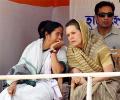
The event will be significant for the Congress and Trinamool Congress leaderships, cementing the proximity during the winter session of Parliament.

Stepped up public expenditure must be accompanied by focused policies, advises Vinayak Chatterjee.

Most employment surveys suffer from drawbacks such as limited data coverage, infrequent data collection, and time lag

With his strong views on Bharatiya economics, his appointment to the RBI board may well presage interesting times, says Archis Mohan.

The payroll estimates, released by the EPFO based on its enrolment, threw up some contrasting trend between September 2017 and February 2018.

If people can lobby me for making changes in policies that goes against the country's interest, I won't keep myself in this position, says the vice chairman of NITI Aayog.

Decisions at a G20 meet are not added to the UN climate negotiations.

China's economy is worse than it really is, but then these are emblematic of the baffling self-congratulatory mood that exists in India today.

The manufacturing sector during the fourth quarter recorded a growth rate of 9.3 per cent while the farm sector grew at 2.3 per cent.

India and China met and spoke a lot this year, but failed to produce any meaningful results.

2015 will be a real test for Modi govt.

With wages rapidly rising in China, all is still not lost. Wage costs in India are significantly lower and this fact could still help us turn the tide in our favour.

Be it roads, railways, ports, civil aviation, energy or electricity, the Narendra Modi govt has invigorated all these sectors since it took over, says Arvind Panagariya.

'Poor home work, and a subsequent loss of nerve.' 'This sums up the Modi government's current travails, the stall in key sectors, fading momentum, irritability,' points out Shekhar Gupta.

Ahead of the Parliament session, Prime Minister Narendra Modi on Wednesday reached out to parties appealing them not to come in the way of prosperity of farmers, saying the deadlock over the land acquisition bill is seriously impacting rural development.

Arvind Panagariya speaks about climate change, globalisation and India's economy.

'There is no difference between the earlier government and the present government.' 'They are all following the economic policy based on the Chicago School of thought.' 'This school of thought says the government should have very little role in governing the country and the majority of the work should be handed over to the private sector.' 'This has not succeeded in the US.' 'Yet, it is being tried here by people like Arvind Subramaniam, Arvind Panagariya, Urjit Patel and Raghuram Rajan.'
The Modi PMO is like none other: It is staffed by people who are so low profile that the only dominant personality is the Prime Minister's.

Businessman P C Mustafa wants Indian Americans to return home, Cognizant CEO Francisco D'Souza outlines how Indian tech companies could grow, Gaurav Dalmia has some investment recommendations while Subramanian Swamy warns that India is flirting with a debt trap.

Despite presiding over scores of factories in what is today India's largest garment exporter with 105,000 employees, Ahuja is a modest man with much to be immodest about. He tells Rahul Jacob that the government needs a free trade agreement with Europe fast to ensure a level-playing field with Bangladesh and Vietnam.
As Modi completes a year in office, his cuts in federal welfare spending on the poorest of India's 1.25 bn people are coming in for sharp criticism.
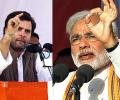
A Narendra Modi administration would believe more in decentralisation than would a Rahul Gandhi administration, says Arvind Panagariya.

'Life will not improve overnight; it will happen in a gradual manner.'

ISB professor Krishnamurthy Subramanian tells Shobha Warrier/Rediff.com that Modi government's continuation of tax terrorism is driving away investors.
Prime Minister Narendra Modi's maiden speech from Red Fort last Independence Day outlined some grand programmes. Shehzad Poonawalla does a quick check on the progress made.

Narendra Modi's pay-off from relaxing labour laws would be huge.

The high-speed train line in a region already well-connected by rail, road and airways may have to struggle to stay viable

The Diaspora is no longer a mere remittance economy. It today claims dual loyalty and demands a say in Indian politics, says sociologist Shiv Visvanathan

In the second and concluding part of his interview, Gurumurthy outlines the two areas he believes the government should focus on.

Modi government has to come up with a robust economic agenda to impress the masses.

The BJP government is no better than the Congress -- as wretched and anti-people. In addition, it is explicitly and aggressively communal, says Venkatesh B Athreya, in a hard-hitting interview to Shobha Warrier/Rediff.com.

'A lot will depend on the first Aayog and the power it derives.'

M R Venkatesh, chartered accountant turned political commentator tells Shobha Warrier/Rediff.com that Modi's war is not against the opposition parties or the Congress but against the bureaucracy and the establishment.
